



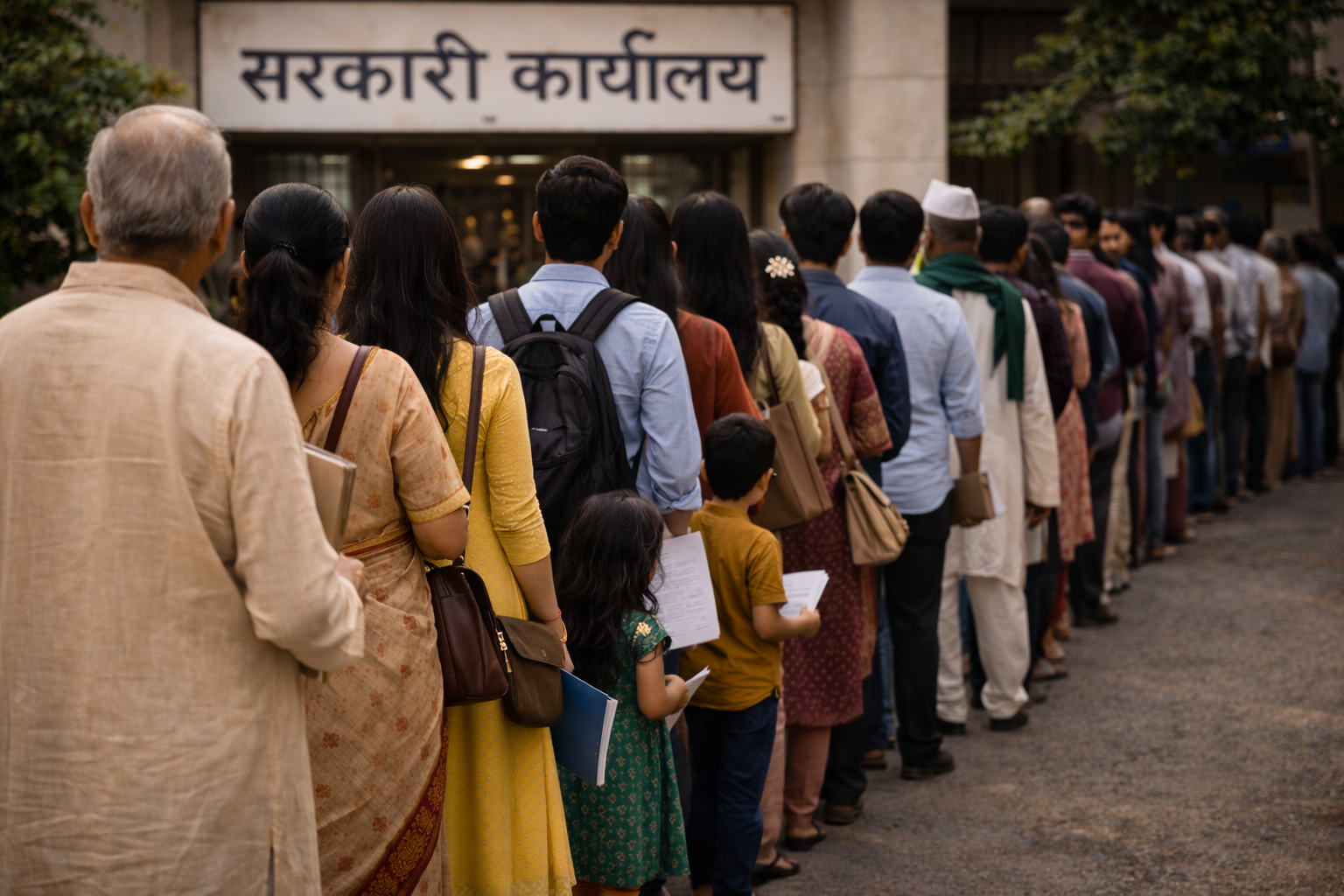
Waiting as a Way of Life: Understanding India’s Bureaucratic Culture
In India, waiting is not an inconvenience.
It is an initiation.
You wait at government offices, at counters without signs, outside cabins with files stacked higher than chairs. You wait for stamps, signatures, approvals, and sometimes for reasons that are never explained. The waiting room is rarely silent, it hums with resignation, hope, frustration, and remarkable patience.
To an outsider, Indian bureaucracy often appears inefficient. To an insider, it is a language one learned slowly, painfully, and collectively.
Bureaucracy in India did not emerge in isolation. It is a legacy shaped by colonial administration, reinforced by post-independence governance, and expanded to manage a population of unmatched scale and diversity. Rules became safeguards. Paper became proof. Process became power. Over time, waiting transformed from a logistical delay into a cultural constant.
In this system, time behaves differently.
Files move slowly, not always because of incompetence, but because accountability is layered, decisions are deferred, and risk is avoided. Waiting protects the system from mistakes, but it also protects individuals from responsibility. When everything requires approval, no one truly owns the outcome.
Yet, within this maze, something uniquely Indian survives.
People learn to adapt. Relationships matter. Knowing who often becomes as important as knowing how. A shared joke, a respectful greeting, or a patient demeanour can move a file faster than urgency ever could. Bureaucracy here is not just administrative, it is social.
This culture of waiting has seeped into everyday life. We wait for infrastructure to improve, for reforms to show results, for systems to catch up with ambition. And while India sprints in technology and entrepreneurship, its institutions still walk carefully, carrying the weight of precedent.
But waiting also shapes resilience.
It teaches endurance in a way few systems do. Citizens learn to negotiate complexity, to persist without assurance, to hope without timelines. In a paradoxical way, bureaucracy becomes a mirror, reflecting both the limitations and the quiet strength of Indian society.
However, patience should not be mistaken for acceptance.
A new India is questioning inherited delays. Digital governance, online services, and transparent frameworks are challenging the old culture of queues and counters. The younger generation does not see waiting as destiny , it sees it as a design flaw. And change, while slow, is undeniable.
Understanding India’s bureaucratic culture is essential for the world engaging with India.
It is not a failure of intent, but a system shaped by history, scale, and caution. To navigate it is to understand India itself, complex, layered, frustrating, and deeply human.
Waiting, in India, is not just about time.
It is about learning how systems breathe, how power pauses, and how people endure.
And perhaps the greatest insight is this, a nation that has mastered waiting is also capable of remarkable transformation, once it decides to move.
Tagged with :